Albania,  Balkan

Camping in Albania

From our last campsite not far from Bar, Montenegro, it was only a stone's throw to Albania.
If you haven't read the post „On the Road in the Balkans", you can find it here.)
Right after the border post, where they checked our passports and vehicle papers, but not our certificates, the roads narrowed.
In Shkodra, the first city we arrived in, we were introduced to the Albanian way of driving and parking. Basically, you can drive wherever there is room, regardless of prohibition signs, road markings and common sense.
Parking is still much easier. You can do that even where there is no space. For example, in the middle of the roadway. Put on your hazard lights and get out. Preferably without looking back first to see if there is a potential danger of having the driver's door ripped off.
This inevitably leads to congestion and chaos.
"I'm already getting used to their driving style," Seraina calls over from the wheel as she weaves her way through the avalanche of cars. "And I'm even starting to enjoy it! But what kind of culture shock must they get when they drive in Switzerland for the first time!"
The advantage of our motorhome: We are seen and one gives way before us. So we quickly found the way to the next ATM, where we withdrew a few thousand Albanian LEK and then made off.

On Lake Koman

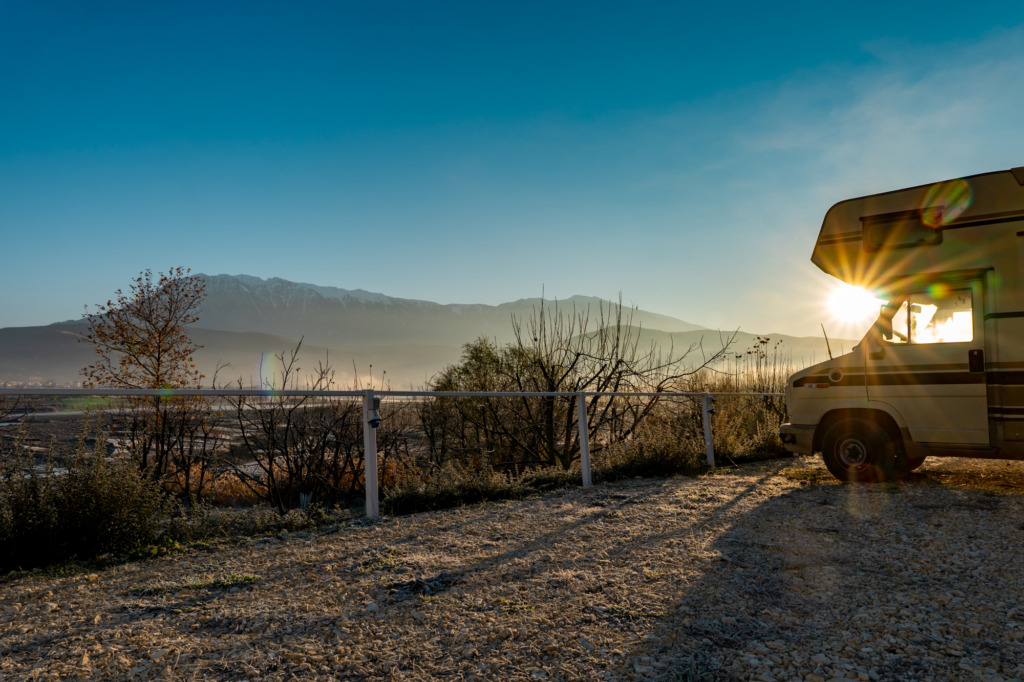
At Lake Koman, far away and yet only 20 or 30 kilometers from the hustle and bustle, we discovered a quiet camping on the guesthouse and farm of an Albanian family directly on the lake. In the middle of December, we were the only guests here. We enjoyed this peace very much. Here we gathered first impressions of rural life in Albania, planned our route through the country and got acquainted with all the animals here at the "Animal Farm" of the Agora Camping.

Especially the young cat, which I affectionately nicknamed "Pfötli" (little paw), I would have loved to take with me right away. The first night she even slept with us in the Loki.
If we were to pass by Lake Koman again, we would definitely stop here again.
We had picked out a few places in Albania after watching a documentary about the country on Youtube. We read through blogs about Albania and got advice from friends. In the process, the same few names kept coming up: Gjrokaster, the city of stones, in the south, Berat, the city of a thousand windows in the center, Ksamil on the coast, the lagoons of Butrint and Karavasta, Lake Ohrid on the northern Macedonian and Greek borders. Tirana, the capital also sounded interesting.

Kruja

The next destination, two hours south of Camping Agora, was the medieval fortress of Kruja, which the Albanian national hero Skanderberg successfully defended with his League of Lezha against the Ottoman Empire. It was only after Skanderberg's death that it finally fell to the Ottomans.
Impressively, the fortress towers above the town of Kruja with a magnificent view all the way to the Albanian coast. Today it is a museum, surrounded not by Ottomans but by restaurants and souvenir stores.

In the Diviaka-Karavasta National Park

After a traditional lunch we continued to the Karavasta lagoon. Here we saddled our bikes for the first time on this trip the next day and rode over sandy paths and bottomless puddles through the Divjaka-Karavasta National Park. The lagoon is a paradise for birds. So we saw flamingos, gulls and other water birds on the way, but not the Dalmatian pelican for which the national park is famous.
Unfortunately, a fundamental problem was more than evident here as well: litter wherever the eye looks. In Albania, a poor country that often reminded us of Latin American or Asian countries, people still seem immune to pollution. And it didn't seem to make any difference whether we were in a national park or not, because the national parks, of which there are a whole 14 in Albania, are often protected only on paper.

Berat - City of Windows

In Berat, the next city on our list, we caught a perfect day for a bike ride through the mountains. All day we enjoyed a steel blue sky, but also frosty temperatures in the morning and evening.
We rode on mostly unpaved roads through small villages and olive groves until it became too steep and we had to push the bikes; the snow-capped, over 2000 meter high Tomorr mountain always in sight.
You can see at first sight why Berat is called "the city of a thousand windows". With its typical white houses with many small windows, the UNESCO World Heritage Site is one of the most important attractions in Albania. And rightly so, in my opinion. The picturesque buildings and mosques give the city a fairytale appearance.
With the dear hosts of Natyra e Qetë Caravan Camping, we were in good hands. And again the only guests for miles.
DSC08629-Pano
Then we drove further along the coast through the winding Llogora National Park. Our Loki had to struggle with the mega-steep roads. For the fast transit, a new tunnel is being built, but its completion will surely take a few more years. But for us travelers it would be a shame to miss the mountain road through the park. I would even call it probably the most scenic highway on this side of the Adriatic or Ionian Sea.

Ksamil on the Sea

Now we are stranded in Ksamil, a popular seaside town in southern Albania in a thunderstorm that seems to last a few more days. We don't mind much; it gives us a bit of a break from all the driving and a little time for computer work.
Ksamil at the lagoon of Butrint is quite small. Now in winter nothing is going on here. All hotels and restaurants are closed. But the many construction sites and new or half-finished hotels point to the tourist boom in the summer months.

Gjirokaster - In the stony city

A few days later in Gjirokaster, we feel right at home. After nothing was happening in Ksamil (almost all of the countless restaurants and hotels were closed) we wanted to breathe a little more life and mountain air.

We got perfectly served in Gjirokaster. The small town lies on the edge of the wide Drino river valley in southern Albania. It is framed by barren mountain ranges bathed in beautiful light-shadow play from the winter sun.

The city of stones, at the same time one of the oldest Albanian cities and since 2005 a UNESCO World Heritage Site, is, as its epithet suggests, built of many stones abundant in the surrounding area. The houses, roofs, streets and striking fortresses are as much a part of the cityscape as the castle towering over the old town.

Even in Gjirokaster tourists are rare in winter; quite different probably in the summer months, as the dozens of inns and boutique hotels suggest.

Many restaurants are closed as well. So on the second day, we wander a bit lost through the steep old town under the castle until we finally find something at about 2 pm.

We are escorted into the restaurant and before we can hastily retreat, we are sitting in the middle of an Albanian celebration.

A large table is occupied by animatedly chatting people, young to old, as many women as men. We order and the restaurant owner, who also speaks some German, tells us that these are his firefighter buddies.

The music blares next to our little table. When the first people begin to dance to the traditional music, we already suspect something ominous.

By the time our food arrives, we think we're already off the hook. The fire department garrison now dances around the table and through the whole restaurant holding hands.

And just as we devour the first delicious bites, first Seraina, then I am also grabbed by the hands and we melt stumbling in the circle of the dance. Good, we have already had a glass or two of red wine!

Everyone laughs and sings, and as quickly as it started, people clap their hands and the celebration is over.

Sweaty, we sit back down to our lunch. Albania, as you would imagine it.

The next day, the last of the year, we explore Gjirokaster on the bikes.

I pull Seraina up the steep streets with the e-bike until we arrive at the top of the town. Here we are treated to wonderful views far into the distance. Through the narrow alleys we roll down town until the brakes smoulder.

The old town of Gjirokaster is probably one of the most beautiful we have seen in a long time (well, Mostar in Bosnia probably comes close).

Nevertheless, also on this immaculate day, we are happy to get back to our camper, where we can enjoy the endless starry sky over a campfire at Julian's campsite, three kilometers outside of town.

Somewhere up there (or in there) is written what the new year has in store for us. We just have to look closely.

DSC08776

Click here for the next article about Albania:

The two documentaries below are in German. But I'm sure you can find some good ones about Albania in English too.


  • Part 1 about the north of the country
  • Part 2 about the East, South and with an exciting ending in Tirana

Sign up for the newsletter below to make sure you don't miss anything from Nimmerwoland. We welcome comments and hope you enjoyed the read!

Photographs 📸 - Travels 🌎 - Stories 📒 In English and German

5 Comments

Leave a Reply to Simon Cancel reply

Your email address will not be published. Required fields are marked *

en_USEnglish